
If you’re looking for love at first sight, don’t come to Buenos Aires, by Anna Laura Praxedes dos Santos
By Anna Laura Praxedes dos Santos, University of Pennsylvania '29
July 23, 2026
f you’re looking for love at first sight, don’t come to Buenos Aires.
Argentina isn’t the kind of place that sweeps you off your feet the moment you arrive. Its air doesn’t hit you all at once. Instead, you breathe it in little by little, day after day, until one morning you realize it has quietly become a part of you.
Every corner holds a small surprise: a brightly painted sidewalk, a statue honoring the inventor of Braille, colorful umbrellas floating overhead. The city doesn’t ask for your attention; it simply keeps offering tiny moments of wonder until, almost without noticing, you’ve fallen in love.
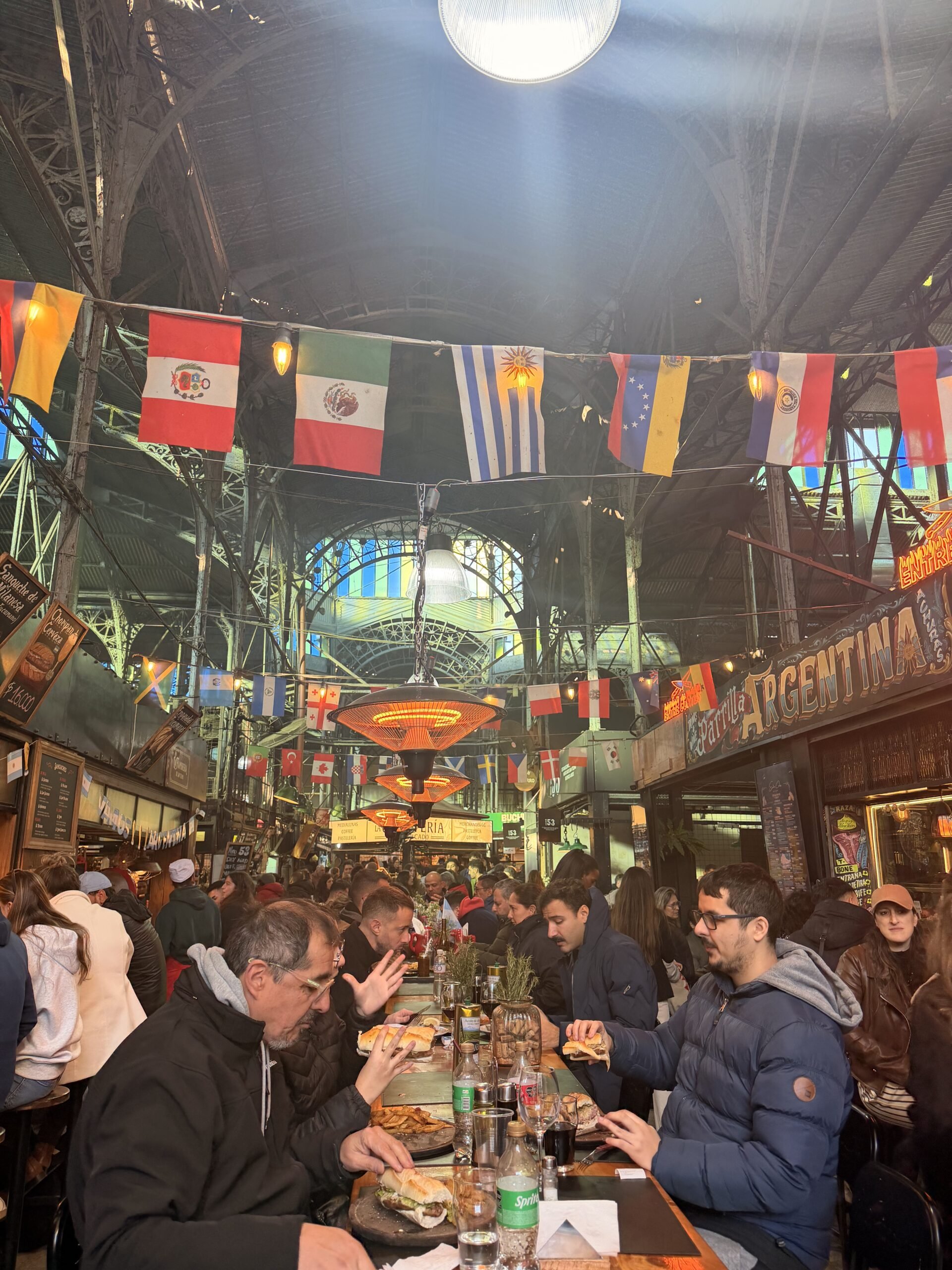
Buenos Aires is a city that rewards patience. It refuses to be consumed in a weekend itinerary or a checklist of famous landmarks. You can visit the Obelisk, stroll through Palermo, admire the colorful houses of La Boca, and still leave without understanding what makes this place so magnetic. The real CABA reveals itself in the spaces between destinations: in the conversations overheard on the subway, in the old man greeting you with the brightest smile and knowing your lunch order–a suprema napolitana con fritas–before you even say it, in the alfajores that you buy at a kiosco until you find the perfect one.
Life here unfolds at a different rhythm. People linger over coffee instead of rushing out with paper cups in hand. Lunch stretches into long conversations, and dinner begins when many other cities are already asleep. At first, I resisted this slower pace. Coming from an environment where productivity often measured the value of a day, I felt guilty for sitting in a plaza with nowhere to be. But Buenos Aires slowly taught me that not every hour needs to be optimized. Sometimes, the most meaningful part of a day is simply sitting at a restaurant after lunch and watching it happen.
There is beauty in the imperfections, too. The sidewalks are uneven, the buses are occasionally late, and historic buildings stand beside modern apartments without much concern for architectural harmony. Yet those imperfections somehow make the city feel honest. Buenos Aires has never tried to present itself as flawless. Instead, it wears its history openly, allowing every generation to leave its mark. You can see the old and new together, making a kind of imperfect harmony.
Perhaps that is what makes walking here so captivating. Every neighborhood feels like a conversation between different eras. Elegant French-inspired buildings stand across from colorful murals protesting political injustice. Grand bookstores occupy former theaters, while tiny family-owned bakeries offer you an insight into Paraguayan or Chilean cuisine that survived generations of immigration. You are constantly reminded that millions of individual stories have shaped this city.
What surprised me most was not the architecture or the food—it was the people. Argentines have a remarkable ability to make strangers feel included. Conversations begin easily, even with my imperfect Spanish. I spend hours talking with Mariel, my host mom, about politics, places to go, my family in Brazil, and a million other things. As someone living abroad, far from home, I found that those small interactions mattered more than I expected. They transformed an unfamiliar city into a place where I gradually felt I could live.
Living in Buenos Aires also changed the way I thought about language. Before arriving, I worried about speaking imperfect Spanish. I expected every grammatical mistake to create distance between myself and others. Instead, I discovered that communication depends far more on generosity than on perfection. People patiently listened, corrected me with kindness, and often celebrated the effort itself. Somewhere between mispronounced words and improvised sentences, I stopped trying to sound fluent and started trying to connect.
By the time I noticed how attached I had become, it was already too late. I had developed favorite cafés, preferred subway exits, familiar walking routes, and favorite thrift stores that no longer required a map to get to.
I now understand why so many people return to Buenos Aires. It is not because every street is beautiful or every day is extraordinary. It is because the city quietly becomes part of your habits, your memories, and eventually your identity. It teaches you to appreciate the ordinary until the ordinary itself feels extraordinary.
If you’re searching for instant excitement, Buenos Aires may disappoint you. But if you’re willing to stay long enough to let the city reveal itself at its own pace, you’ll discover something far more enduring than love at first sight. You’ll leave carrying pieces of it with you: in your Spanish accent, in your appetite for long conversations, in your slower walks, and in the quiet certainty that somewhere across the world, there is a city moving the same rhythm as you.